FOR SOLAR ECLIPSES
Sonnenfilterfolie für Teleskope, Ferngläser & Kameraobjektive — DIY-Sonnenfolie, OD 5.6
READY FOR 2026, 12th AugustEN ISO 12312-2 certified solar viewer — safe for direct viewing of the 12 August 2026 total eclipse.
Incl. VAT. Free EU shipping over €50.
- AAS-recognized
- CE Category II
- EN ISO 12312-2
- QR-verified
Ships in 24 h from inside the EU on tracked delivery.
30-day returns on unopened items — no questions asked.
Demand peaks close to the date — order early.
It’s today — view safely.amazon · prefer Prime?
The same EN ISO 12312-2 certified glasses are listed on Amazon Germany — useful if you'd rather use Prime delivery or existing credit. Buying direct here is usually cheaper and ships from the EU.
CUT-TO-SIZE SOLAR FILTER FILM - OD 5.6
One Film. All Your Optics. The Sun, Safely.
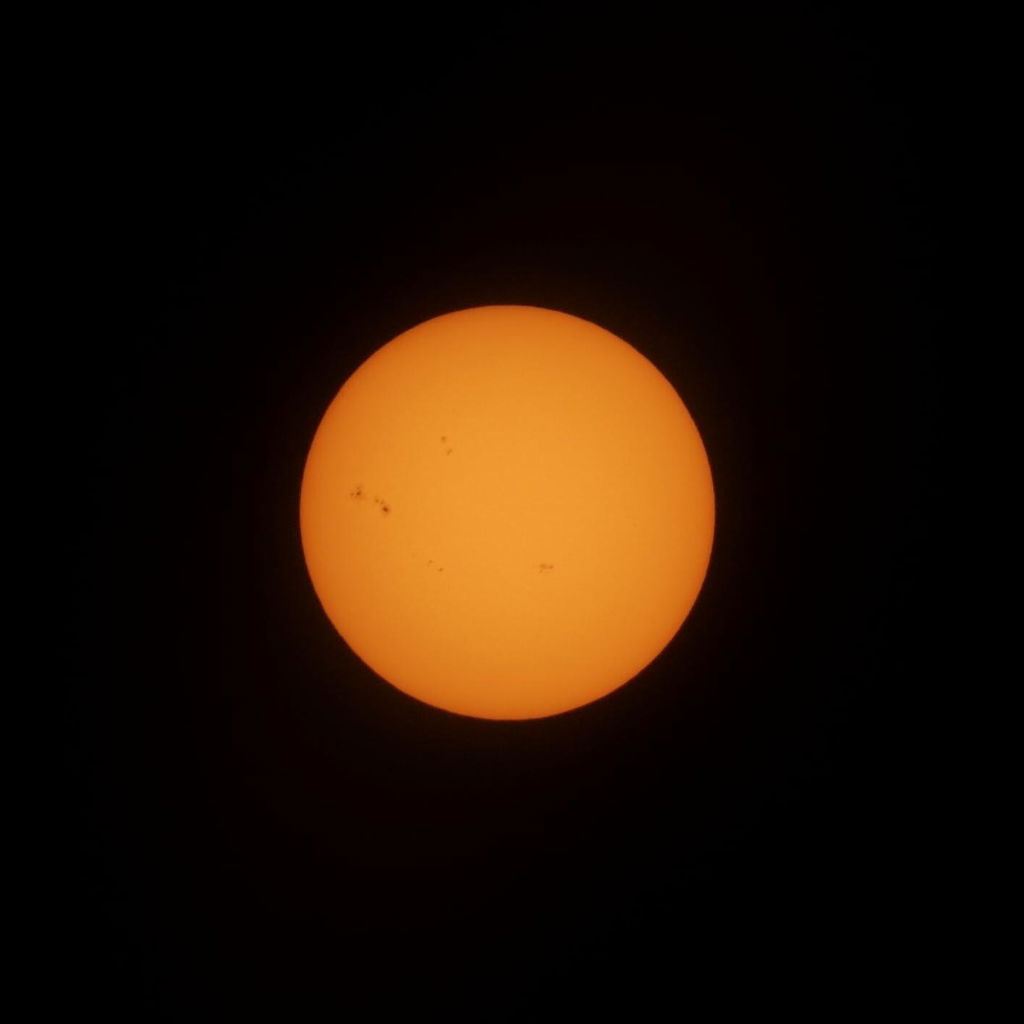
Cut the film to fit your optics: telescope, binoculars, spotting scope or camera lens. Tested to ISO 12312-2 by an accredited laboratory, it blocks 99.9998% of sunlight and reveals a sharp, detailed orange solar disc. Get ready for the eclipse on 12 August 2026.
Create Filters for All Your Optics
Camera Lenses
Build a front-mounted filter for solar photography with your compatible lenses. Attach it securely in front of the front element.
Spotting Scopes
Mount the film over the front aperture of your spotting scope for safe terrestrial-style solar observing.
Telescopes
Make a custom front filter for telescopes and large apertures. Always in front of the tube - never at the eyepiece.
Binoculars
Cut two front filters, one for each objective lens, mounted on separate cells.
The Right Filter for Every Aperture
Measure, Cut, Mount, Check
1. Measure Your Aperture
Note the outer diameter of the tube or lens and cut a cardboard ring slightly larger than the front of your instrument.
2. Cut to Size
Lay the film flat and cut a disc with a 10 mm margin on each side. Handle it by the edges without creasing the surface.
3. Mount It Securely
Place the disc on the cardboard ring and fix it with tape - flat and firmly held, with no risk of slipping off.
4. Check Before Every Use
Inspect the film against a bright light: no pinholes, scratches or tears. Cover the finderscope and replace if damaged.
About this model
Das Absolute Eclipse Solarfilterblatt ist ein flexibler Sonnenfilm für die sichere, direkte Beobachtung und Fotografie der Sonne durch optische Instrumente. Schneide das Blatt auf die gewünschte Größe zu und befestige es über der vorderen Öffnung eines Teleskops, eines Fernglases, eines Spektivs oder eines Kameraobjektivs, um Sonnenflecken, planetarische Transite und Sonnenfinsternisse zu beobachten — oder um deinen eigenen maßgeschneiderten Sonnenfilter zu einem Bruchteil der Kosten eines fertigen Filters zu bauen.
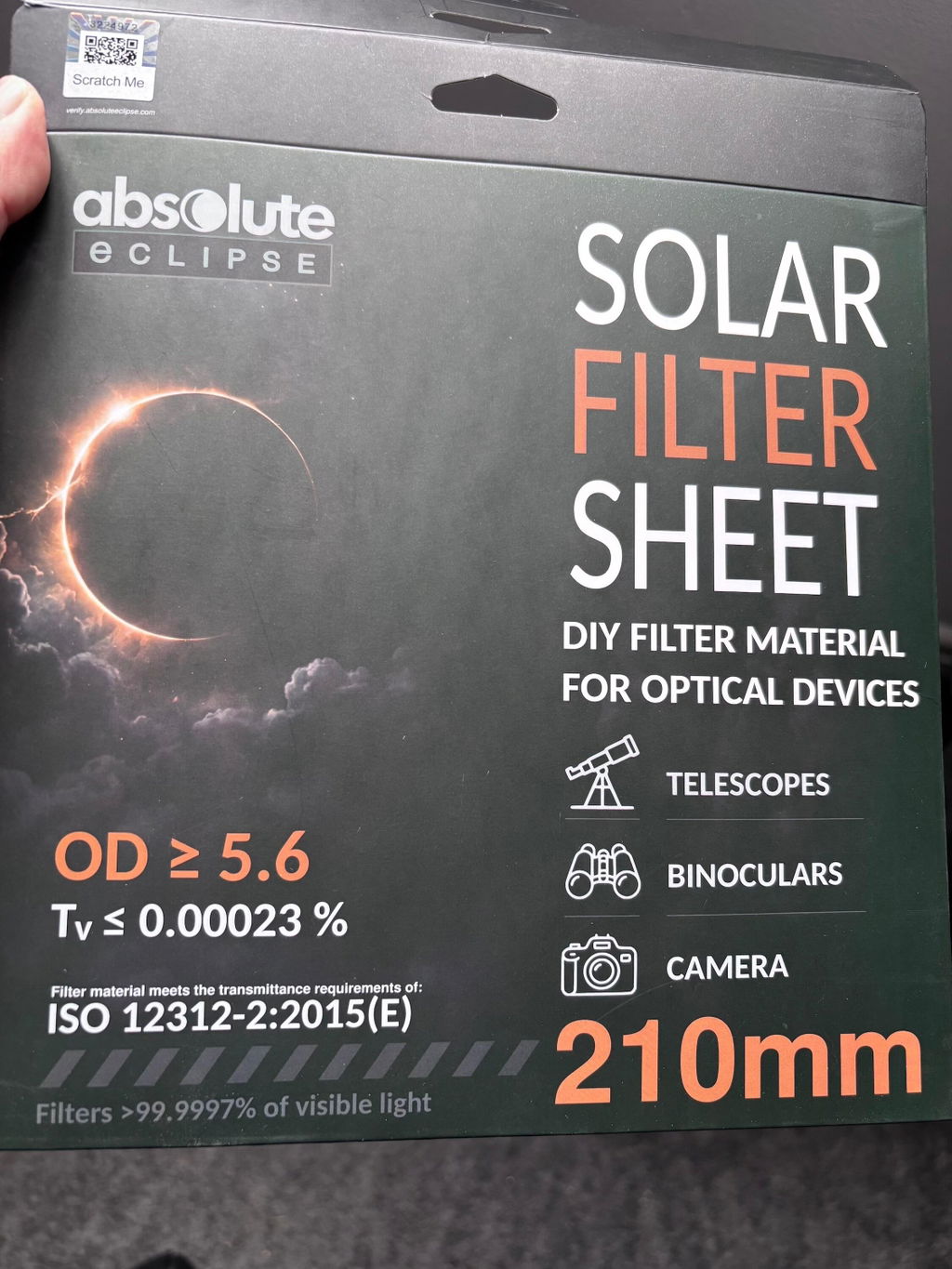
Der Film ist ein aluminisiertes Polymer, das nicht mehr als 0,00023 % des sichtbaren Lichts durchlässt — eine optische Dichte von mindestens OD 5,6 — und reduziert die ultraviolette, sichtbare und infrarote Strahlung der Sonne auf ein angenehmes Betrachtungsniveau, wobei eine scharfe, natürliche orangefarbene Sonnenscheibe mit klaren Sonnenfleckendetails dargestellt wird. Das Filtermaterial wird unabhängig von ICS Laboratories (ein nach ISO/IEC 17025 akkreditiertes Prüflabor) getestet.
Erhältlich in drei quadratischen Größen — 100×100 mm, 150×150 mm und 210×210 mm — um alles von einem Kameraobjektiv bis zu einem großen Refraktor oder Fernglas abzudecken. Messe die Öffnung deines Instruments, schneide das Blatt zu und lasse dabei mindestens 10 mm Überlappung auf jeder Seite, und sichere es über der vorderen Öffnung mit einem starren Rahmen, Halter oder Klebeband. Positioniere die silberne reflektierende Seite zur Sonne und die schwarze Seite zum Instrument.
⚠ Sicherheit
Dieser Filter muss immer das erste optische Element zwischen der Sonne und deinem Instrument sein. Setze ihn niemals hinter das Okular oder eine Linse, wo konzentriertes Sonnenlicht durchbrennen und sofortigen, dauerhaften Schaden verursachen wird. Überprüfe den Film vor jedem Gebrauch und verwende ihn nicht, wenn er zerkratzt, durchlöchert oder geknickt ist. Beaufsichtige Kinder jederzeit.
Wie man es benutzt
- Bester Sonnenfilter für eine Kamera — wie man wählt und warum ein ND-Filter kein Sonnenfilter ist
- Wie man die Sonne & eine Sonnenfinsternis fotografiert — die vollständige Anfängeranleitung
- Kameraeinstellungen (ISO, Blende, Verschluss) — der Spickzettel für Belichtung
Hersteller: SIA Gravitis Enterprise Limited, Lauku iela 7-4, Cēsis, LV-4101, Lettland.
Specifications
Specifications
- Certification
- Material tested by ICS Laboratories (ISO/IEC 17025)
- Optical density
- OD 5.6 — transmits ≤ 0.00023% visible light
- Blocks
- Ultraviolet, visible & infrared radiation
- Material
- Aluminised polymer film
- Sizes
- 100×100 mm · 150×150 mm · 210×210 mm
- Use
- Telescopes, binoculars, spotting scopes & camera lenses
- Mounting
- Silver side towards the Sun, black side to the instrument
How to view safely
Certified — but only if you use them right
-
01
Measure your aperture
Measure the front aperture of your telescope, binoculars or lens before cutting.
-
02
Cut & mount over the front
Trim the sheet leaving at least 10 mm overlap on every side, and secure it over the FRONT aperture — never behind the eyepiece or lens.
-
03
Inspect, then observe
Check the film for pinholes, scratches or creases. Position the silver side towards the Sun and observe. Supervise children at all times.
Do
- Mount the filter over the FRONT aperture, before any lens
- Leave at least 10 mm overlap and secure it firmly
- Face the silver reflective side towards the Sun
- Inspect the film for damage before every use
Don't
- Place the filter behind the eyepiece or a lens — it will burn through instantly
- Use the film if scratched, pinholed or creased
- Leave gaps where direct sunlight can bypass the filter
- Leave children unsupervised during observation
Plan your viewing
Be in the right place on 12 August 2026
Bulk & wholesale
Buying for a school, event or resale?
Per-unit price keeps dropping with volume. Order in bulk here, or talk to us for pallet pricing, custom branding and invoicing.